Category:
 Author:
 Date:Apr 11, 2026
Prime Days: The Weekday Pattern Behind Your Best Trading

Not every day of the trading week carries the same weight. Markets have a rhythm: some sessions open carrying residual noise from the weekend, others arrive loaded with scheduled catalysts, and some close out the week under the pressure of expiries and positioning. The texture of each day isn't identical, and neither is a trader's ability to navigate it.
For many traders, the highest-quality execution doesn't appear randomly across the week. It concentrates. Certain weekdays produce a different quality of decision-making: cleaner entries, more deliberate management, outcomes that sit consistently above the trader's baseline. When that pattern is strong enough and repeatable enough to show up in the data, it's what TradeMedic calls Prime Days.
What does Prime Days mean in trading?
Prime Days is a measurable capability: a trader's performance quality concentrating around specific weekdays, consistently outperforming their results on other days. It isn't about preference or routine in the motivational sense. It's a documented pattern: certain days act as a reliable stage for a trader's best work to show up, session after session.
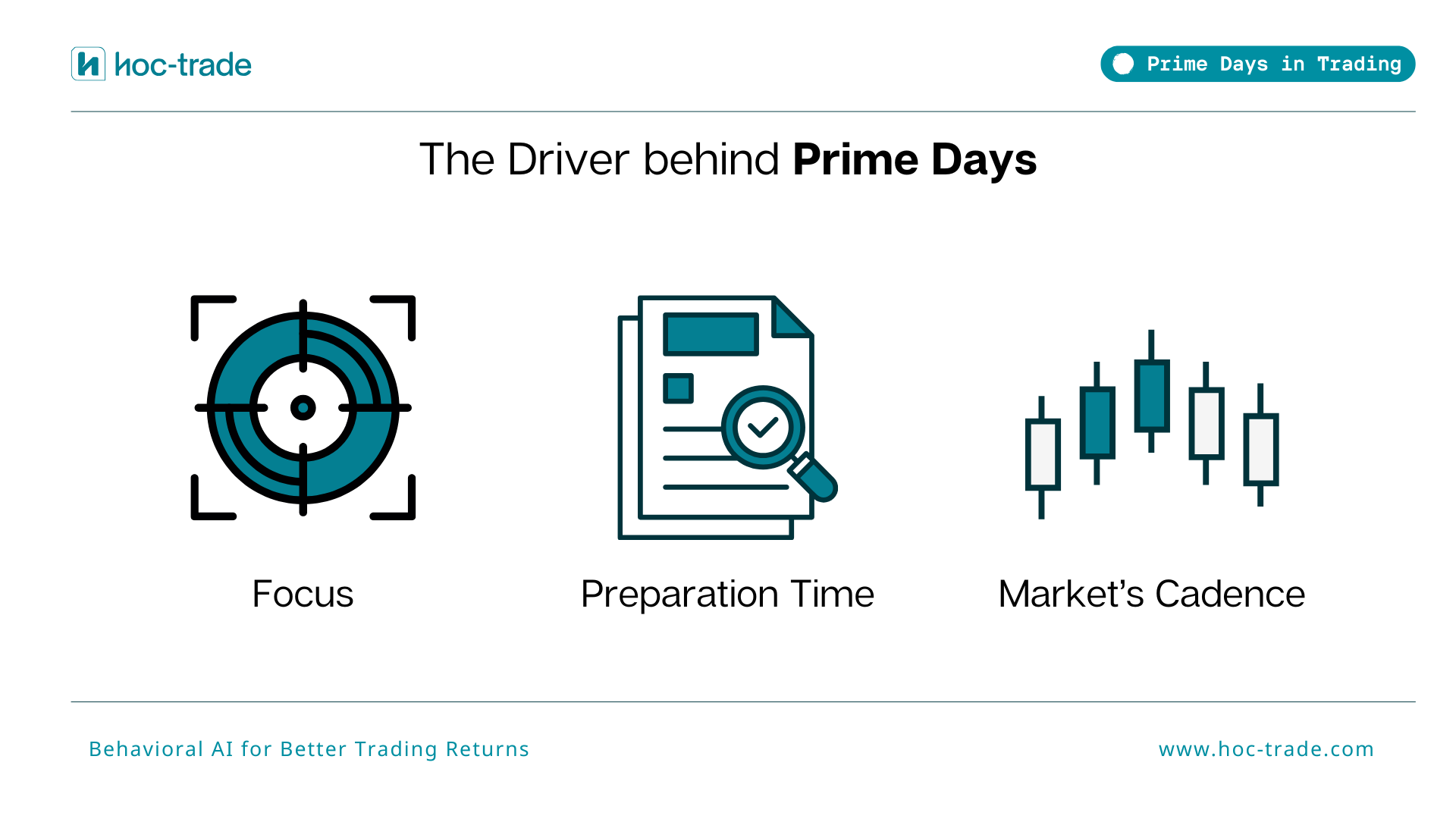
The sources of that concentration can vary. For some traders the driver is personal: particular weekdays allow fewer competing demands, more preparation time, or deeper focus during the session. For others, it's structural. Each day of the week has its own typical market character, shaped by regular news events, liquidity shifts, and recurring volatility patterns. Prime Days captures the overlap between those conditions and when a trader's execution is most consistent.
How does weekday structure affect trading performance?
Markets don't behave uniformly across the week, and experienced traders know it. Mondays can carry elevated volatility as participants absorb weekend developments and re-price expectations for the week ahead. Wednesdays often bring concentrated activity around the monthly US CPI release. Fridays can turn sharp when double or triple witching sessions stack options and futures expiries together, compressing decision windows and amplifying moves.
These structural differences matter because they interact with a trader's own strengths and preparation habits. A trader who does their best work when there's a clear framework for the session may find Wednesdays around CPI give them exactly that clarity. Another trader may thrive on Mondays, when fresh positioning creates directional setups that suit their style. The day-specific dynamics don't help everyone equally, and that unevenness is part of what Prime Days captures.
How does Prime Days show up in real trade behaviour?
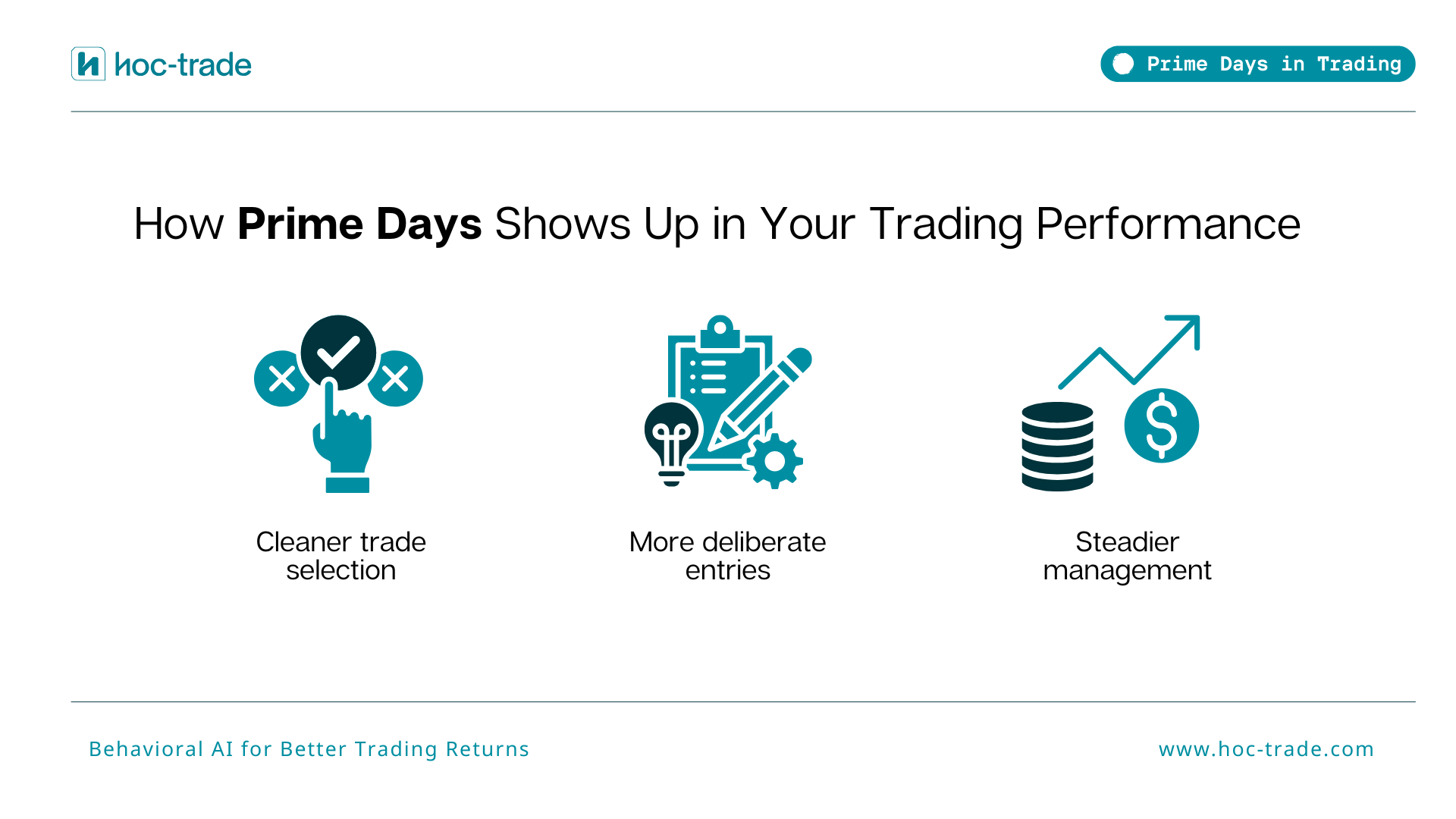
In practice, Prime Days tends to show up in how trades are prepared, entered, and managed, not just in whether they close green. On the days where a trader performs best, there's often more room upstream: time for analysis, a clearer read on the session's structure, and a decision process that isn't compressed. That additional bandwidth translates into specifics: tighter entry timing, more deliberate position sizing, management that reflects intent rather than reaction.
Over enough trades, the sessions linked to a trader's prime weekdays start to look distinct in their sequencing. The decisions aren't rushed. The exits reflect a plan. The outcomes separate from what the same trader produces on days where focus is thinner or market conditions sit outside their comfort zone. It's a pattern that becomes visible in retrospect, even when individual trades vary.
This kind of consistency is also documented in patterns like
Why is Prime Days considered a trading edge?
An edge in trading is useful when it's repeatable. A single strong session on a Thursday doesn't tell you much. A pattern where Thursdays consistently produce your clearest execution, across dozens of trades and varied market conditions, tells you something structural about yourself and your process.
That's what makes Prime Days an edge rather than noise. It reflects a stable relationship between a specific weekly context and a trader's execution quality. The signal isn't that every prime-day session will be profitable; markets don't cooperate that neatly. The signal is that the conditions for your best decision-making recur on a predictable schedule. Knowing that, you can prepare differently, size with more confidence, and treat those sessions with the seriousness they've earned.
Edges like this don't require a new strategy or a different instrument. They require knowing yourself in the data. You can read more about how TradeMedic surfaces these kinds of personal patterns at
What does the data say about weekday performance patterns?
TradeMedic detects Prime Days across a dataset of 500,000+ trader accounts, classifying each trader's trade history by weekday of opening and measuring performance distribution across those groups. Where a statistically meaningful separation exists between one or more weekdays and the rest, Prime Days is confirmed as an active pattern for that trader.
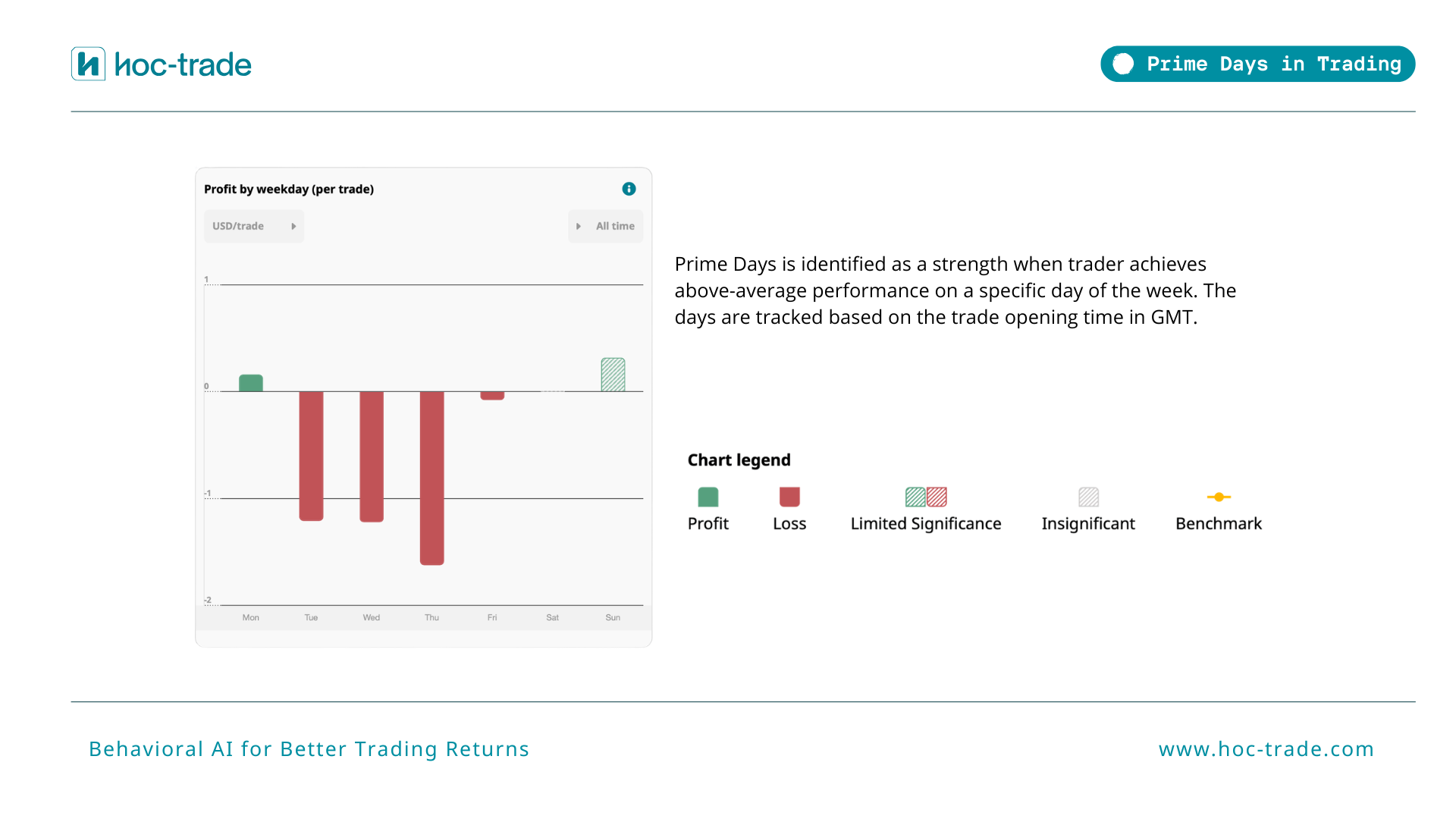
In our dataset, weekday-linked performance variation ranks among the most consistent improvement opportunities identified by TradeMedic. A detailed breakdown with trader-specific statistics is available through the TradeMedic tool.
How can traders use Prime Days to improve their results?
The first step is recognition. Most traders haven't looked at their performance broken down by weekday, so the pattern remains invisible. Once it surfaces, it shifts how you approach the trading week: not every session needs equal preparation or equal risk allocation.
On the days where your data shows strong consistent execution, the conditions are in place. Preparation time, market structure, personal focus: whatever combination drives your edge, it's converging. Those sessions reward deliberate engagement. On other days, the same combination may not be present, and scaling down or staying selective isn't a lack of discipline; it's an accurate read of your own performance environment.
Repeatability is the key word. Seen across enough trades, Prime Days becomes less about the calendar and more about understanding when focus and market rhythm line up for you specifically. That convergence is where a trader's best work reliably shows itself, and it's worth knowing exactly when it is.
TradeMedic AI analyses over 60 behavioural patterns, including blindly following momentum, across 500,000+ trader accounts. Visit TradeMedic to see how it works and get your own personal analysis.
Watch How Prime Days is A Weekday Pattern Behind Your Best Trades